Nobody publishes how construction builds its hiring function, so we built the picture ourselves. We researched 817 profiles of in-house recruitment professionals working for UK construction, infrastructure and built-environment employers, read each one individually, and grouped them to the 150 employers they work for. Three recruitment models run across that market, and which one a business has built tells you more about how it hires than its headcount does.
Full team — self delivery
18 employers · 371 recruiters. A named owner of the function, business partners fronting the divisions and an extensive direct sourcing team beneath, on a median team of 17. These are the only teams in the study that also carry employer brand, talent management, and systems and data — 18 people across 11 of the 18 teams, against 6 people across all 132 employers running the other two models. One recruiter covers 325 employees and carries 6.1 live vacancies, the most comfortable gearing in the study, and people stay longest here at 3.9 years with the firm.
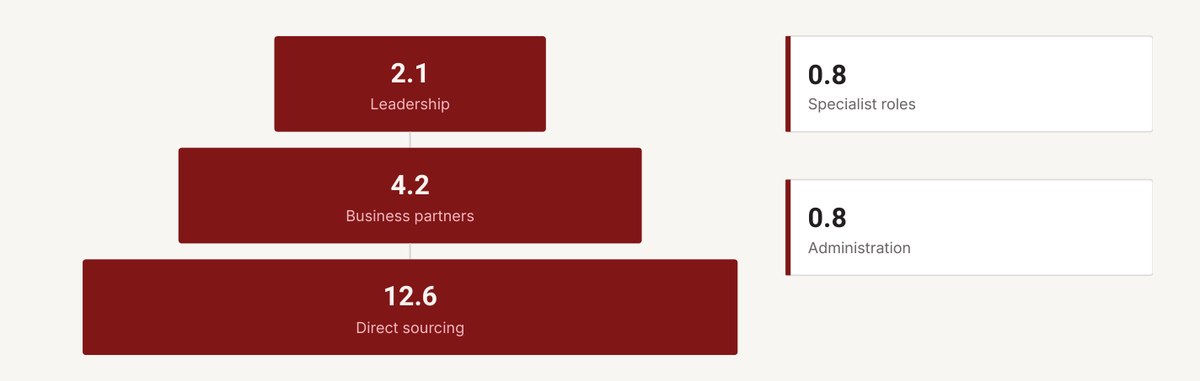
Each figure is the average number of people holding that role in one team running this model, so the five boxes together describe a single team rather than the model as a whole.
TA business partnering
34 employers · 194 recruiters. Built around major project, regional and divisional coverage rather than around headcount. Resourcing — putting people already on the payroll onto schemes while hiring against the gaps — is 37 per cent of this model against 2 per cent of base administration, and the discipline has no real equivalent outside project businesses. Partner-titled roles are 28 per cent of the model, the highest of the three, and the median employer running it carries 2,232 people. Coverage is the widest in the study at 462 employees per recruiter and advertised vacancies the lowest at 5.0, because a meaningful share of the demand these teams service never becomes an advert. It is filled internally.
Base administration
98 employers · 245 recruiters. Two-thirds of the employers in this market run it, on a median team of 2, and 44 of them with a single person covering the whole business. It carries the heaviest advertised workload in the study at 8.8 live vacancies per recruiter against 6.1 in a self-delivery team, which leaves little room for proactive direct sourcing once the requisition list is covered.
At two people the model splits, and both shapes are deliberate. Dragados UK & Ireland pairs a recruitment manager with a recruiter, which puts delivery capability in place with a clear owner over it and a defined route between the two seats. Geobear staffs its two at Head of Talent Acquisition and Talent Lead, buying leadership seniority at a size most functions only reach at three times the headcount, and giving the business a single senior point of contact for hiring from the outset.
The roles inside the function
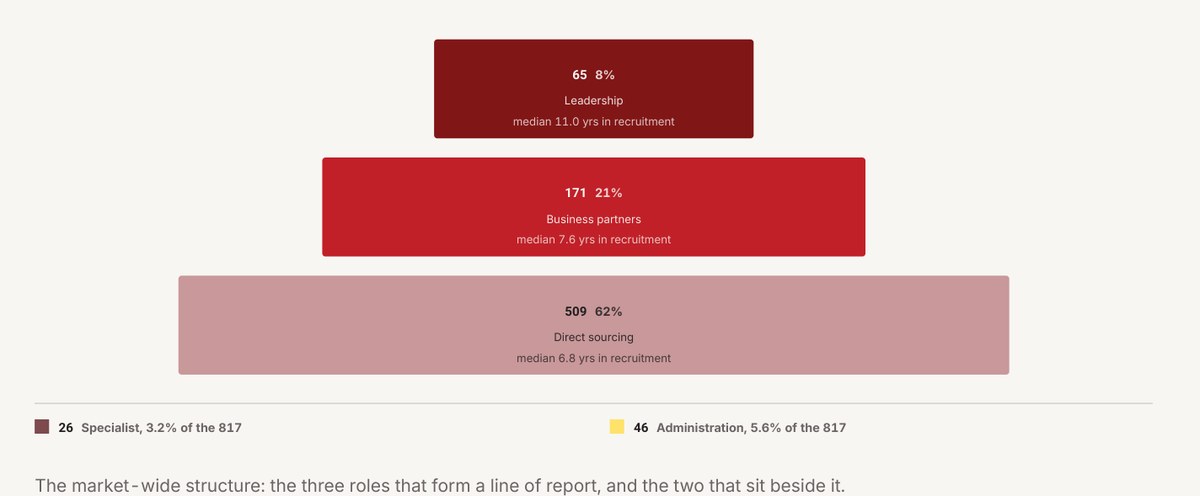
Job titles in this function are inconsistent between firms, which is exactly why they are worth coding. We read all 817 titles and placed each person in one of five roles. Three form a line of report — 65 TA leaders, 171 business partners and 509 people sourcing and delivering directly — and two sit beside it, 26 specialists and 46 in administration. Direct sourcing is 62 per cent of the market and the core of all three models. What differs between them is what sits around that core, not the core itself.
What it means for hiring
Employer size is the weakest of the three explanations for how a function is built. Coverage differs by under a quarter across the three models while their median team sizes differ by a factor of eight, and the correlation between employer headcount and employees per recruiter comes out at 0.02. The addressable question is always which specific business is thin, never which size band.
For anyone approaching one of these teams, the model tells you who you are talking to and what they have capacity for. For anyone building one, the second hire is the one that sets the shape: adding delivery beneath a manager builds capacity, adding seniority alongside buys judgement before the volume arrives, and the study shows which a firm has chosen long before it has a team.
Method, limits and accuracy
The paper closes on a methodology and sources section that sets out how it was built and what it cannot tell you. Every profile was read individually rather than scraped to a keyword, related entities were rolled up to their parent before any per-employer figure was calculated, and live advertised vacancy counts were taken by cross-referencing LinkedIn against each company's own careers page. It will still not be perfect: a study built by reading and coding 817 individual records will carry some inaccuracies, and everything in it comes from publicly available information, which can be incomplete, out of date or simply wrong.
What is in the report
Twenty-three pages. A chapter on each model carrying its org chart, gearing, tenure and the firms running it; the three compared side by side with the fifteen largest in-house teams named; a chapter on the five roles with their experience ranges; and the full methodology, limits and sources, including the complete list of all 150 employers studied.